
Ghaziabad · 20 May 2026 · 7 min read
Koyal Enclave (Ghaziabad): Hindon Airport + Sahibabad Metro Link, A Practical 2026-27 Investment Playbook
A practical, May 2026 playbook for evaluating Koyal Enclave and the Trans-Hindon belt: Hindon Airport's operational updates, early-stage metro corridor proposals via Hindon Civil Terminal, and a livability-first investor checklist with relevant KLR CTAs.
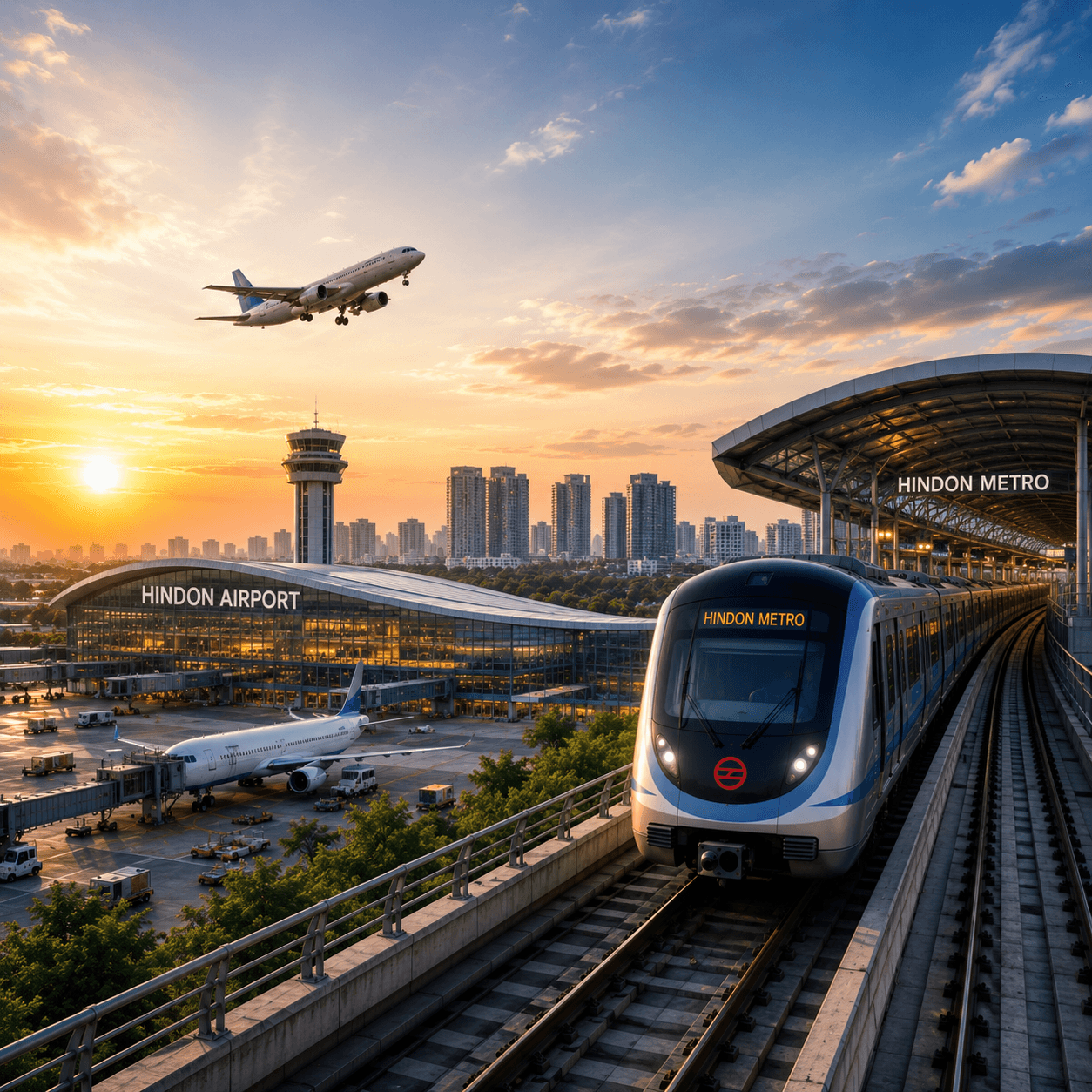
NCR investors often chase the “next” corridor story and miss the quieter compounding micro-markets that become investment-ready when two things align: (1) everyday livability (schools, hospitals, retail, last‑mile roads), and (2) a credible step-change in regional connectivity (airport access, metro links, or regional rail).
Koyal Enclave—around the Trans‑Hindon / Sahibabad belt—sits in that “quiet compounding” category. It already benefits from established end-use demand across East Delhi–Ghaziabad, and it is now seeing fresh headline catalysts: Hindon’s civil enclave activity + expansion work and a proposed metro corridor concept that would explicitly connect via the Hindon Civil Terminal.
This note is written for May 2026 decision-making. It is not a promise of returns; it is a framework to evaluate whether this micro-market fits your time horizon, risk tolerance, and documentation discipline.
Market context (May 2026): Trans-Hindon is shifting from “commuter belt” to “multi-node city”
Ghaziabad’s Trans‑Hindon and Sahibabad side has historically been priced as a commuter market: buyers wanted a Delhi-adjacent address, practical budgets, and daily connectivity. Over the last few years, the market has gradually added more “city” features:
- Airport utility (Hindon Civil Enclave) for select domestic routes and improved time-savings for some travelers.
- Regional rail + highway access patterns that make parts of Ghaziabad a credible base for people working in East/central Delhi, Noida, and institutional catchments along NH‑24.
- Healthcare + retail anchors that reduce the “we must drive into Delhi/Noida for everything” friction.
For Koyal Enclave specifically, the practical “investment readiness” thesis is less about a single announcement and more about reducing friction: faster airport access, fewer interchanges for work commutes, and stronger everyday amenity depth.
What’s new and why it matters now
1) Hindon Airport is active—and the authorities are openly discussing capacity constraints and expansion
On the official AAI airport page, Hindon is described as a civil enclave at Hindan Air Force Station with a terminal designed around 300 passengers per hour and multiple Indigo and other routes listed. It also shows a “last updated” date of 20 May 2026, which is a useful signal that the information is being maintained.
Separately, Hindustan Times reported (published 31 March 2026) that the summer schedule effective April 1 planned fewer scheduled flights than winter, while also quoting officials on ongoing expansion efforts—more parking bays, discussions with the IAF for additional bays, and a short-term terminal expansion project underway along with passenger facilities. The key point for property decision-making is not the exact flight count; it’s that operational constraints + expansion planning are being acknowledged publicly, which often precedes capex execution.
Why this matters for property: airport-adjacent markets don’t move only on “airport opens” headlines. They tend to reprice in phases—first on proof of operations (routes + reliability), then on connectivity improvements (metro / road capacity), and finally on employment/footfall (commercial activity). Hindon’s story is already in the “proof of operations + identified constraints” phase.
2) A proposed metro corridor concept explicitly routes via Hindon Civil Terminal (early stage, but high signal for accessibility)
In late April 2026 coverage, a proposed Vaishali–Gokulpuri corridor “via Hindon Civil Terminal” has been discussed, with reporting indicating the Ghaziabad Development Authority has asked DMRC to prepare a DPR for a corridor that would improve access to Hindon’s civil terminal.
This is not an “approved tomorrow” project. But for investors, the signal is important: metro planning is being framed around Hindon as a connectivity node, not just a peripheral add-on.
Why this matters for Koyal Enclave: if a corridor alignment strengthens the Sahibabad–Vaishali–Hindon linkages (and integrates with other transit nodes), the perceived commute friction can fall even before construction begins—because tenant/buyer decision-making often prices in likely connectivity paths once a DPR cycle is visible.
3) The “livability triangle”: healthcare + daily retail + essentials
Koyal Enclave’s practical advantage is that it sits near a set of “daily life” anchors that matter for rental stability:
- Hospitals (e.g., the Yashoda Hospital ecosystem in the broader Kaushambi/Indirapuram catchment).
- Everyday retail + groceries (DMart and comparable anchors across the Indirapuram/Vaishali belt).
- Neighbourhood shopping (malls/high-street formats in the wider vicinity).
In NCR, rental yield resilience often comes from these anchors more than from a single future infrastructure promise. The proposed connectivity catalysts simply strengthen the demand base.
Investor lens: what to underwrite (not what to “hope”)
Think of the Koyal Enclave thesis in two layers:
1) Base case (already true): end-use demand exists; the area works for day-to-day living; tenants are available when inventory is realistically priced and well maintained. 2) Upside case (under development): improved airport experience + proposed metro connectivity reduces friction, potentially improving liquidity and stabilising perceived “distance risk”.
Your underwriting should be conservative on the upside case and strict on documentation.
Buyer/investor checklist (practical, NCR-specific)
A. Connectivity reality check (15 minutes of homework that saves 15 months of regret)
- Map your primary commute and two backups: peak-hour road, metro-first route, and hybrid route (metro + last mile).
- For Hindon Airport, check: pickup/drop-off time reliability, parking approach, and realistic travel time windows.
- Treat “metro proposed” as a scenario, not an assumption. Your base case should still work without it.
B. Documentation and payment discipline
- Verify seller/title chain, registry status, and dues (society/authority, if applicable).
- If buying new supply, insist on RERA verification (registration details, sanctioned plans where applicable) and avoid “soft commitments” that aren’t traceable.
- Budget for friction costs: interiors, maintenance, lift/parking configuration, and any society transfer charges.
C. Rental yield underwriting (avoid vanity yields)
Use a simple conservative model:
- Expected monthly rent range (be conservative).
- Vacancy assumption (1–2 months a year is not uncommon in real life).
- Maintenance + brokerage + furnishing refresh.
If the deal still works on a conservative rent number, the asset is investment-ready for your profile.
D. Noise + operational risk (airport adjacency isn’t free alpha)
Airport adjacency can improve accessibility, but also introduces:
- Noise sensitivity for some tenants/buyers.
- Route schedule changes and operational constraints.
This doesn’t mean “avoid it”; it means price it correctly and prioritise layouts where livability holds.
Related opportunities (KLR internal shortlist)
If your thesis is “Trans‑Hindon / Ghaziabad with strong livability + rental depth”, consider these live internal options while keeping your own due diligence standards:
- Project option (Ghaziabad): Indirapuram Signature Floors — boutique low-rise ownership style with a rental‑yield narrative, pricing currently shown around ₹0.95 Cr – ₹1.65 Cr on the live site.
- Property option (Ghaziabad): Indirapuram Park-Facing Builder Floor — ready inventory with a “move-in / rent-out” use case, pricing label on the live site shown as From Rs 1.35 Cr.
You can also browse all current inventory here:
For a shortlist call focused on documents + exit plan (not brochure narratives), reach the advisory desk: Contact Kumar Linkers Realty.
Risk notes (what can go wrong, and how to manage it)
1) Project timelines slip: Metro proposals can take time. Plan your finances so the asset works without the metro catalyst. 2) Liquidity is micro-location specific: Two homes 900 meters apart can have different resale depth based on approach road, parking, and society quality. 3) Mispriced “airport premium”: Do not pay a premium for “near airport” unless accessibility is proven for your use case. 4) Documentation shortcuts: NCR punishes paperwork laziness. If the file feels messy, the exit will feel messier.
Advisory view (KLR stance for May 2026)
Koyal Enclave fits a very specific investor profile:
- You want livability-first real estate (end-use depth, essentials nearby).
- You prefer risk-managed yields over speculative appreciation.
- You will hold through a 24–60 month window while connectivity narratives mature.
The Hindon + metro-corridor headlines are best treated as optional upside. The real decision is whether the micro-market’s base case works for you: practical commute, strong tenant pool, manageable documentation risk, and an asset you’d be comfortable holding even if timelines move slowly.
If you want, share your budget, holding horizon, and preferred asset type (ready vs under-construction), and we’ll align a shortlist that matches your downside limits: Talk to KLR.